Filter by:

Filter by published date

Viewing 61–90 of 113 results. Go to first page
Woman holding a turkey on a platter.
partner

The Modern Invention of Thanksgiving

The holiday emerged not from the 17th century, but rather from concerns over immigration and urbanization in the 19th century.
Woodcut illustration of "Witches Apprehended" showing the water test accused witches would undergo. Stamford has its own history of witch trials.

Haunted Stamford: 1692 Witch Trial

In the same year as the Salem Witch Trials, a more common and lesser known witch hunt occurred in Stamford, Connecticut.
Harriet Beecher Stowe imagining her characters.

“Uncle Tom’s Cabin” and the Art of Persuasion

Stowe’s novel shifted public opinion about slavery so dramatically that it has often been credited with fuelling the war that destroyed the institution.
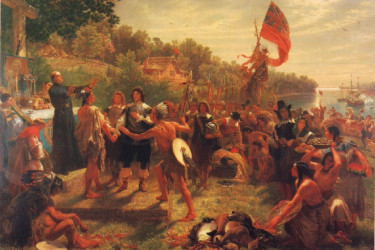
The Founding of Maryland by Emmanuel Leutze (1634).

Bejesuited: America’s First Catholics

A history of Catholic immigration and activity in colonial North America.
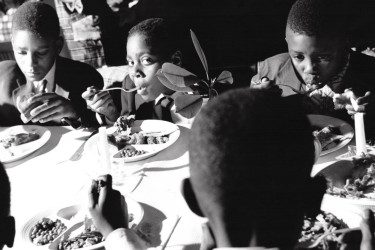
Children eating Thanksgiving dinner in Harlem.

Make Thanksgiving Radical Again

The holiday’s real roots lie in abolition, liberation, and anti-racism. Let’s reconnect to that legacy.
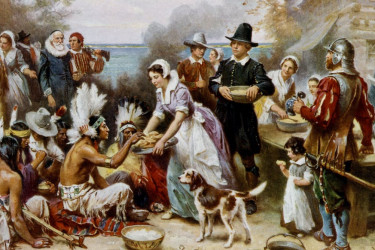
‘The First Thanksgiving, 1621,’ by Jean L. G. Ferris. Library of Congress

How the Plymouth Pilgrims Took Over Thanksgiving – and Who History Left Behind

In some ways, Thanksgiving is a tradition that unites Americans. But the classic image of the Pilgrims obscures important parts of the country’s story.
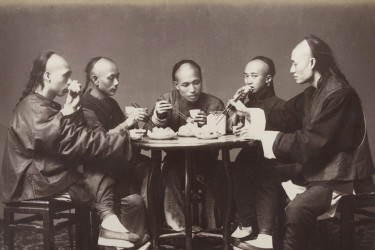
Five men sharing a meal in Qing dynasty China.

Splitting Hairs

Chinese immigrants, the queue, and the boundaries of political citizenship.

The Sum of Our Wisdom

We are told that we are a Calvinist culture, which means very little, and none of that good.
Robert Frost.

Chapters and Verse

Looking for the poet between the lines.
Abstract painting of people embracing.

The Forgotten History of Sex in America

Today’s battles over issues like gender nonconformity and reproductive rights have antecedents that have been lost or suppressed. What can we learn from them?

How America’s Rich Legacy of Fear and Hatred Fuels the Conspiracy Theories of Today

Panic about Catholics, Freemasons, and, later, Jews, is deeply woven into American history, and forms the basis of our fertile culture of conspiracy theorizing.
Illustration of a man typing on his laptop on a rollercoaster ride.

Work Sucks. What Could Salvage It?

New books examine the place of work in our lives—and how people throughout history have tried to change it.
Children in a kindergarten classroom at the Horace Mann School, Tulsa, Okla., 1917.
partner

Yes, Schools Should Teach Morality. But Whose Morals?

Belief that schools must teach moral values is older than public schools themselves. But whose morals?
A crowd of tourist superimposed over images of Salem attractions and a cemetery.

Salem’s Unholy Bargain: How Tragedy Became an Attraction

Is the cost worth the payoff?
Thomkins H. Matteson's painting of George Jacobs' witchcraft trial in 1855

The Salem Witch Trials Actually Happened in Danvers, Massachusetts

Tensions between Salem and Danvers were there from the start—contributing to the ensuing witch hysteria.
A drawing of a woman looking inside the door of a church where children are playing.

The Quiet Revolution of the Sabbath

Requiring rest, rather than work, is still a radical idea.
Painting of the english surgeon Edward Jenner inoculating a child.

How Far Back Were Africans Inoculating Against Smallpox? Really Far Back.

When I looked at the archives, I found a history hidden in plain sight.

Doing the Work

The Protestant ethic and the spirit of wokeness.
Map of John Proctor's 15 acres of property in Ipswich, MA

"The Crucible" and John and Elizabeth Proctor of Salem

It is worth digging a bit deeper into the family matters between John and Elizabeth.
Cover page of "Cotton Mather's Spanish Lessons." Beige cover with a small red image of a tonsured monastic scribe with a book in front of him, evidentally engaged in scholarship.

Structures of Belonging and Nonbelonging

A Spanish-language pamphlet by Cotton Mather explodes the Black-versus-white binary that dominates most discussions of race in our time.
Samuel Adams.

Hanged on a Venerable Elm

The shadow of Samuel Adams, a crafty and government-wary revolutionary, lingers over the January 6 Capitol insurrection.
People sitting on a hill overlooking a harbor

How We Became Weekly

The week is the most artificial and recent of our time counts yet it’s impossible to imagine our shared lives without it.

Why the History of the Vast Early America Matters Today

There is no American history without the histories of Indigenous and enslaved peoples. And this past has consequences today.
Illustration of the Salem Witch Trials, with a "witch" appearing to levitate books

My Witch-Hunt History, and America's: A Personal Journey to 1692

Revisiting America's first witch hunt — and discovering how much of it was a family affair. My family, that is.
Detail of Anti-Slavery Picnic at Weymouth Landing, Massachusetts (c1845) by Susan Torrey Merritt. Courtesy the Art Institute of Chicago

New England Kept Slavery, But Not Its Profits, At a Distance

Entangled with, yet critical of, colonial oppression and the evils of slavery, the true history of Boston can now be told.
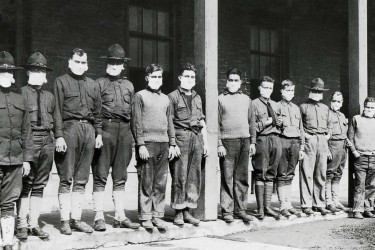
Medical men wearing masks at a US Army hospital

Why Do We Forget Pandemics?

Until the Covid-19 pandemic, the catastrophe of the Spanish flu had been dropped from American memory.
A man standing at a crossroads holding an American flag.

The Wasting of the Evangelical Mind

The peculiarities of how American Christianity took shape help explain believers’ vulnerability to conspiratorial thinking and misinformation.
The book cover for "They Knew They Were Pilgrims."

A History of the Pilgrims That Neither Idolizes Nor Demonizes Them

Historian John Turner tells the story of Plymouth Colony with nuance and care.

On the Insidious ‘Laziness Lie’ at the Heart of the American Myth

Devon Price wonders why we equate sloth with evil.

The Edge of the Map

Monsters have always patrolled the margins of the map. By their very strangeness, they determined the boundaries of the regular world.

Filter Results:

Suggested Filters:

Idea

Person